

Planet
As a shipping company operating worldwide, we need to take responsibility for the environment we operate in. Our strategy has been reshaped to best meet our commitments and continue to help decarbonize our customer’s supply chains. We take a proactive approach to managing our environmental performance.
Scorecard – 2024 Performance

Planet development goals
- Cut carbon emissions by more than 30% from 2019 to 2030 and reach net zero by 2040
- Partner with customers to create and grow the world’s greenest deep-sea shipping services
- Raise the bar of asset life cycle management based on our responsible business philosophy
Read more about our goals and targets on our strategy and governance page.
Climate Change

Emissions to Air
Höegh Autoliners has high sustainability ambitions and is on a clear path to net zero, and our main emission challenge as a shipping company is emissions to air. To meet this challenge, we commit to using only compliant fuel and focus our efforts on reducing our vessels’ fuel consumption. Höegh Autoliners focuses both on more ambitious fuel savings programs and on hull/machinery modifications.

Carbon intensity Indicator (CII)
On November 1st, 2022, amendments to the International Convention for the Prevention of Pollution from Ships (MARPOL) Annex VI entered into force, making it mandatory from January 1st, 2023 to calculate each vessel’s annual operational carbon intensity indicator (CII) and its CII rating. Based on a ship’s CII, its carbon intensity will be rated A, B, C, D or E (where A is the best).
The rating indicates a major superior, minor superior, moderate, minor inferior, or inferior performance level. A ship rated D for three consecutive years, or E for one year, will have to submit a corrective action plan to show how the required index of C or above will be achieved. We are proud to have the best CII rating in the PCTC segment with about half of the Group’s vessels having received a Carbon Intensity Indicator (CII) rating of A-B in 2022.
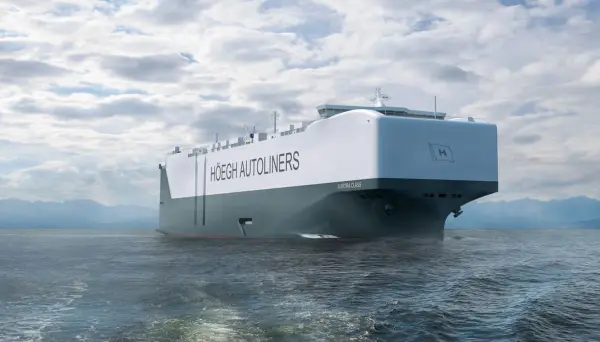
All of our vessels built after 2010 have an engine configuration that can be converted to Methanol in the future. We continue our work on optimizing the fleet to further improve the CII score in the future. All of Höegh Autoliners’ six Horizon class vessels have achieved an A CII rating as they are 40% more efficient than a standard PCTC vessel.
30 by 30, zero by 40
Höegh Autoliners fleet wide KPI for fuel efficiency is aligned with IMO’s and Poseidon Principles standard CII and Annual efficiency ratio (AER). The weighted average AER/CII managed by HTM and our US flag fleet was 5,04 g CO2/ GT*Nm, which is an improvement of 2,1% compared to 2023.
Our target is to improve efficiency by 2% by the end of 2023 and 8% by the end of 2026. To further substantiate our vision to reach net zero operations by 2040, we have adopted a target of a reduction of our AER of more than 30% by 2030 (30 by 30) compared to our 2019 levels to strengthen our position as the leading green PCTC operator. This will put us in a position to partner with sustainability-focused OEMs and continue to develop commercially attractive green propositions.
Vessel Life Cycle
We have been working systematically with emissions reductions and fleet improvements for more than a decade resulting in substantial carbon savings and emissions cuts. The progress has been obtained through continuous investments in new technology and other vessel improvements.
Green Ship Recycling
Höegh Autoliners executes the disposal of old vessels in a manner that is safe for both humans and the environment. All obsolete vessels sailing and declared a total loss are recycled based on the Hong Kong International Convention for the Safe and Environmentally Sound Recycling of Ships. Vessels are dismantled under strict requirements in approved shipyard facilities. Any recycling yard selected must comply with the Höegh Autoliners Supplier Code of Conduct.
In working with qualified Ship Recycling Facilities, there are established management systems, procedures and techniques which do not pose health risks to the workers or have a negative impact on the local community. By choosing established ship recyclers who have facilities that handle toxic waste responsibly and ensure proper safety procedures that protect workers, Höegh Autoliners maintains its strict safety standards when recycling vessels.
Since committing its first vessel to green recycling in 2009, the Group has only disposed of ships through green recycling. The recycling facility is required to be certified in accordance with:
- “Statement of Compliance” in accordance with the 2009 Hong Kong Convention and the IMO 2012 “guidelines for safe and environmentally sound ship recycling” (Issued by an IACS member Classification society).
- ISO 14001 Environmental Management systems
- ISO 45001 Occupational Health and Safety
- ISO 9001 Quality Management
Höegh Autoliners has not recycled any vessels during 2024.